
History through a grain of pollen
05 December 2025
Published online 5 December 2025
Through the lens of fossil pollen, Egyptian researcher, Hader Sheisha, showed how a vanished river arm once served the pyramid builders.
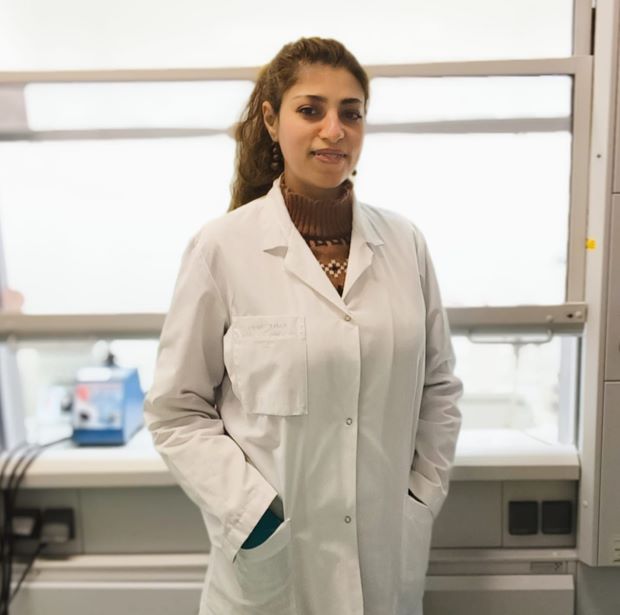
In a small village called El-Hamoul, surrounded by the green fields of Eygpt’s Nile Delta, a young girl gathered herbs from along the irrigation canal. She arranged similar flowers in neat rows on the damp soil.
“The plants that grew all year round never interested me,” recalls Hader Sheisha. “I was fascinated by the ones that appeared suddenly and then vanished with time.”
From that simple childhood game, Hader’s earliest questions about time began to take root: Why do some plants return every season while others disappear forever? How does the Earth remember?
Her family lived in a small house on farmland. Every summer, nomadic Bedouin people arrived with their tents and herds, grazing animals on the stubble left after harvest and fertilizing the soil with their droppings.
As a child, Hadeer watched them, witnessing an early lesson in ecology, a living model of succession ecology, the way one cycle of life prepares the ground for the next.
“I saw it happen right in front of me,” she says. “Everything changed, all the time.”
Perhaps that is why, when Hader now speaks about her research on the Nile and ancient climates, she uses not only the language of geology but also the language of memory. For her, science is not merely an attempt to explain nature; it is an effort to understand how it remembers.
Kafr El-Sheikh to Cairo
Hader studied at the Faculty of Science at Kafr El-Sheikh University, a small city in the Delta. Her class was the university’s very first cohort in geophysics. After graduating, she took a job at a petroleum company in Cairo. The capital was vast and exhausting compared with her hometown, and the industrial world left no space for imagination. Yet she held on to a ritual.
“I used to wake up early to read scientific papers and write about them,” she says. “I would do literature reviews just for myself, as if I were trying to live in another world.”
She didn’t realize that this pull toward something far from her job would eventually lead her to her “real” life.
Then came a phone call from one of her professors: a research team from China was looking for master’s students to study how ancient climate shaped early communities in the Nile Delta. Knowing her interests, he recommended her. Three days later, she told the team she was ready to travel with them to Shanghai and begin her master’s degree.
Pollen: the microscopic stories of nature
In China, Hader learned how something almost invisible, like a fossilized grain of pollen, could hold an entire history. She began studying ancient pollen, those microscopic particles that carry life from one flower to another and remain preserved in layers of soil for thousands of years.
“Their outer shell is incredibly strong,” she explains. “Each grain remembers the kind of plant it came from, the climate it lived in. From a single pollen grain, you can reconstruct the vegetation, the presence of water, even the animals that once lived there.”
When she talks about her work, you can still sense the wonder of the girl from El-Hamoul. It’s as if she is still collecting flowers, but this time under a microscope.
Finding a Forgotten Nile
Years later, Hader joined a study published in PNAS in 2022: the discovery of the Khufu Branch, an ancient arm of the Nile that once reached the Giza Pyramids.
By analysing pollen and sediment, the team showed that this long-lost river channel had helped transport the enormous stones used in pyramid construction.
For Hadeer, the discovery was more than an archaeological fact; it was a confirmation of the idea that nature remembers.
“The water disappeared,” she says, “but the plants that once grew on its banks left their traces in the layers of these pollens. From those traces, we could reconstruct the river, the climate, the people, as if we see all of that with our own eyes.”
She was recovering an entire history from the remains of grains from beside the Nile.
That branch of the Nile is not here for us to see now, but it has not vanished completely. It had left its imprint, written in pollen grains that we can still see, question, and read.
History as Slow Movement, Not Sudden Change
One of Hader’s most striking findings was that the transition from herding to farming in ancient Egypt was gradual, not abrupt.
“There was an overlap of about five hundred years between the latest herders and the first farmers,” she says. “They lived together, exchanged knowledge. The shift wasn’t violent, and it didn’t happen all at once.”
That small observation contains an entire worldview: history does not unfold through revolutions, but through slow transformations, “like a plant quietly changing the direction of its growth.”, She adds.
Nature knows how to blend the old with the new without erasing either. And perhaps Hadeer knows this too, even her most rigorous research reads like a lesson in coexistence between times.
Science as Memory
Today, Hader is a postdoctoral researcher at the University of Bergen in Norway, studying ancient ecosystems and their relationship to climate change in the Nile Valley and North Africa.
But she says she never truly left her village. “I feel like I’m still playing the same game I started as a child,” she tells me. “Back then, I collected flowers from above the ground, now I collect their traces from beneath it.”
What Does the Earth Remember?
What distinguishes Hader is her sense of time.
Every grain of pollen, every faint trace, tells a story we can listen to if we pay attention.
Asked what she had learned from all this, she paused before answering:
“I learned that life never really disappears,” she said. “It only changes its form and waits for someone who knows how to see it.”
That, perhaps, is why her research feels like a story about all of us.
Yes, it’s about fossilized pollen and sediment cores, but it’s also about the humans who built the pyramids, the way they lived, the food they ate, the animals they depended on. It’s about the nature that kept reminding them of what they were.
doi:10.1038/nmiddleeast.2025.204
1 – Interview. Hadeer Sheisha
2 – Sheisha, Hader, et al. Nile waterscapes facilitated the construction of the Giza pyramids during the 3rd millennium BCE. PNAS, 119 (37) e2202530119
https://www.pnas.org/doi/full/10.1073/pnas.2202530119
3 – Tamisiea, Jack. A Long-Lost Branch of the Nile Helped in Building Egypt’s Pyramids. The New York Times.
https://www.nytimes.com/2022/08/30/science/pyramids-nile-river-construction-egypt.html
05 December 2025
21 October 2025
24 August 2025
Sign-up to receive our e-alert update every two weeks to keep up with everything new on the portal.
Sign up for e-alerts
Stay connected: